Inside Washington's Starter Home Plan: What Practitioners and Advocates Need to Know
“The Starter Home Plan didn’t invent its approach — it scaled one. BHI spent years proving what it takes to move Black families in the Puget Sound region into homeownership: address the whole system, not one barrier at a time. The Plan was built by BHI network partners on that foundation, and it applies those lessons to low- and moderate-income families across the entire state.”
- Kris Hermanns, WA Starter Home Plan Project Lead
Event Recap: WHRC Spotlight Series
The Core Challenge: It's Supply, Not Demand
Good news! Washington families are ready to buy starter homes. They're actively looking for affordable homeownership options. Here's the problem: we're simply not building them fast enough. Home values in Washington are increasing faster than median incomes, and the number of new starter homes being built has slowed dramatically compared to previous decades. In the early 1980s, roughly 40% of new homes built in the U.S. were under 1,400 square feet; today, fewer than 10% are. We didn’t just slow production, we stopped building the product. In short: demand is not the barrier to homeownership. Supply is.

This is exactly why Washington State's Legislature called for a comprehensive strategy to address the housing crisis through increasing production of affordable homes. Enter the Washington Starter Home Plan (SHP).

Attendees of the WA Homeownership Resource Council’s Spotlight Series received a detailed update on the SHP on September 23, in an informative conversation between Elizabeth Perez, WHRC Executive Director, and Kris Hermanns, WA Starter Home Plan Project Lead, and BHI Consultant. Here’s what you need to know.
What is the Starter Home Plan?
Facilitated by Civic Commons in partnership with the Washington State Housing Finance Commission, the SHP is a multi-year, research-backed strategy grounded in 11 hypotheses and data from more than 50 national reports and studies. Rather than focusing only on getting buyers "ready to purchase," the SHP targets the real barrier: building an ecosystem that can produce more affordable homes at scale.
The plan uses a systems-based development approach—building systems that optimize standardization, off-site construction techniques, integrated development ecosystems, and repeatable processes and designs. This isn't just an incremental improvement; it's a fundamental redesign of how we produce for-sale starter homes, once again.
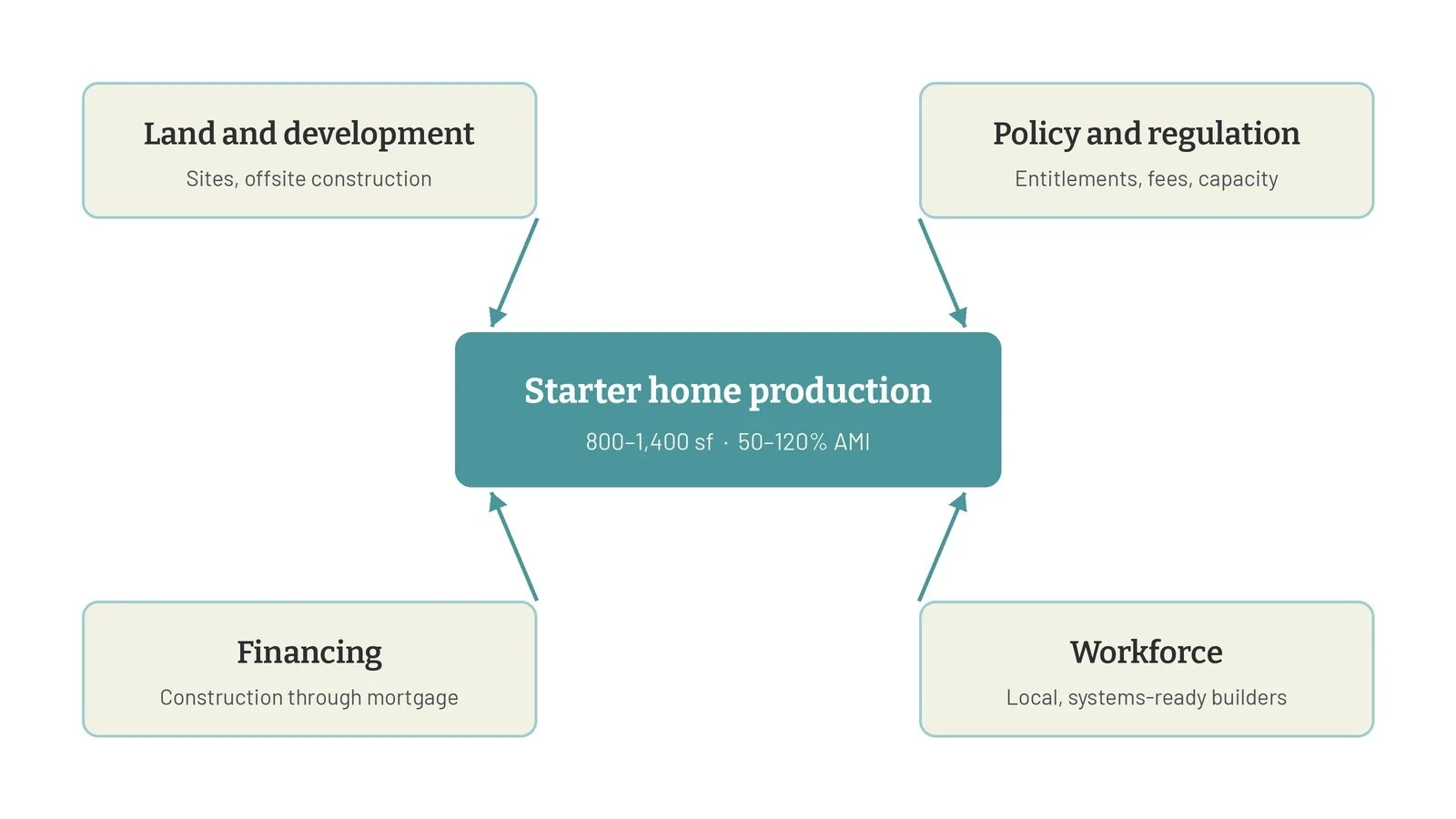
The plan works across four focus areas at once—land and development, financing, policy and regulation, and workforce—because each is a key lever of change, and none of them moves the needle on its own.
What Success Looks Like
Over the next five to ten years, success means more smaller developers building systematically across multiple jurisdictions, lenders offering financing products suited to affordable building using offsite methodologies, a trained workforce ready to implement these methods, and any family ready to buy finding a home in their price point. The SHP Ecosystem Paybook includes a detailed list of success metrics. Still, the ultimate test is whether a teacher, a firefighter, a carpenter, and a retail worker can realistically achieve homeownership.
Already in Motion
Since its release, the SHP has accomplished significant milestones: the townhouse design competition was completed, and its seven winning designs are moving toward permit-ready plans; a local jurisdiction policy guide was created; the team helped pass land banking legislation, launched a Workforce Subnetwork, and created two new offsite financing program opportunities. The team has secured a $1.75 million state appropriation for the SHP Demonstration Program, is initiating the launch of a Housing Innovation Hub, commissioned an economic impact study, and delivered a MOD X Accelerator training to 40 people. The team has also leveraged private sector financing to implement the Starter Home Plan’s top priorities.
Addressing Real Concerns
Questions about off-site construction quality and workforce impacts are legitimate. The SHP team is transparent: past off-site construction efforts have had mixed results because they approached it as a one-off rather than at scale. That's changing here. The difference is designing with repeatability and volume in mind from day one, resulting in major cost savings.
Rather than taking this on faith, the demonstration project will compare off-site and traditional stick-built homes side by side, sharing what they learn publicly. Offsite construction won't compete with traditional building methods—it will complement them. It also creates workforce opportunities in new construction technologies, and career pathways for a new generation of workers interested in innovative building methods.
Rooted in Racial Equity
The SHP builds directly on lessons learned from the Black Home Initiative—the plan was developed by a project team led by BHI network partners, and it carries BHI’s racial equity framework into how the plan was designed. SHP is designed to serve households making 50-120% of area median income across diverse Washington communities, making homeownership accessible to low- and moderate-income families.
How to Get Involved
Practitioners and prospective pilot communities: Watch for the Demonstration Program RFP this fall and join one of SHP’s active work groups.
Also:
- Join the October 13 Walk Your Plans event
- Participate in Learning Labs 1 and 8 at the October Housing WA Conference
- Attend the Housing Innovation Hub Summit on October 19 in Spokane connect
- Share the updated local jurisdiction policy brief with city planners and elected officials in your community.
A Shared Priority
WHRC and its network work every day to help families and households across the state to get ready for homeownership and sustain it once they get there. The Starter Home Plan is the roadmap for making sure there are attainable homes for these households to buy. If we align readiness, counseling, financing, and housing production, we can create stronger communities all over Washington.
Learn more: www.GetHousingBuilt.org | Contact: k.hermanns@starterhomeplan.org