“I do this work because I want to help people see their dreams happen. It's a cool thing - whether it's giving somebody keys to their first home or helping a community organization build units or expand their community center.” - Uche Okezie. Real Estate Development Director, HomeSight
By Johanna Lundahl, Communications Lead, Black Home Initiative
The Black Home Initiative Partner Spotlight Series
Uche Okezie greets me at the front door of the HomeSight office in a soft grey sweater. She offers me a drink, and we make small talk over a gurgling coffee maker in the office breakroom. Once seated at the conference table, we discuss her professional journey. Her quiet smile widens as she recounts her early days in the affordable housing ecosystem. 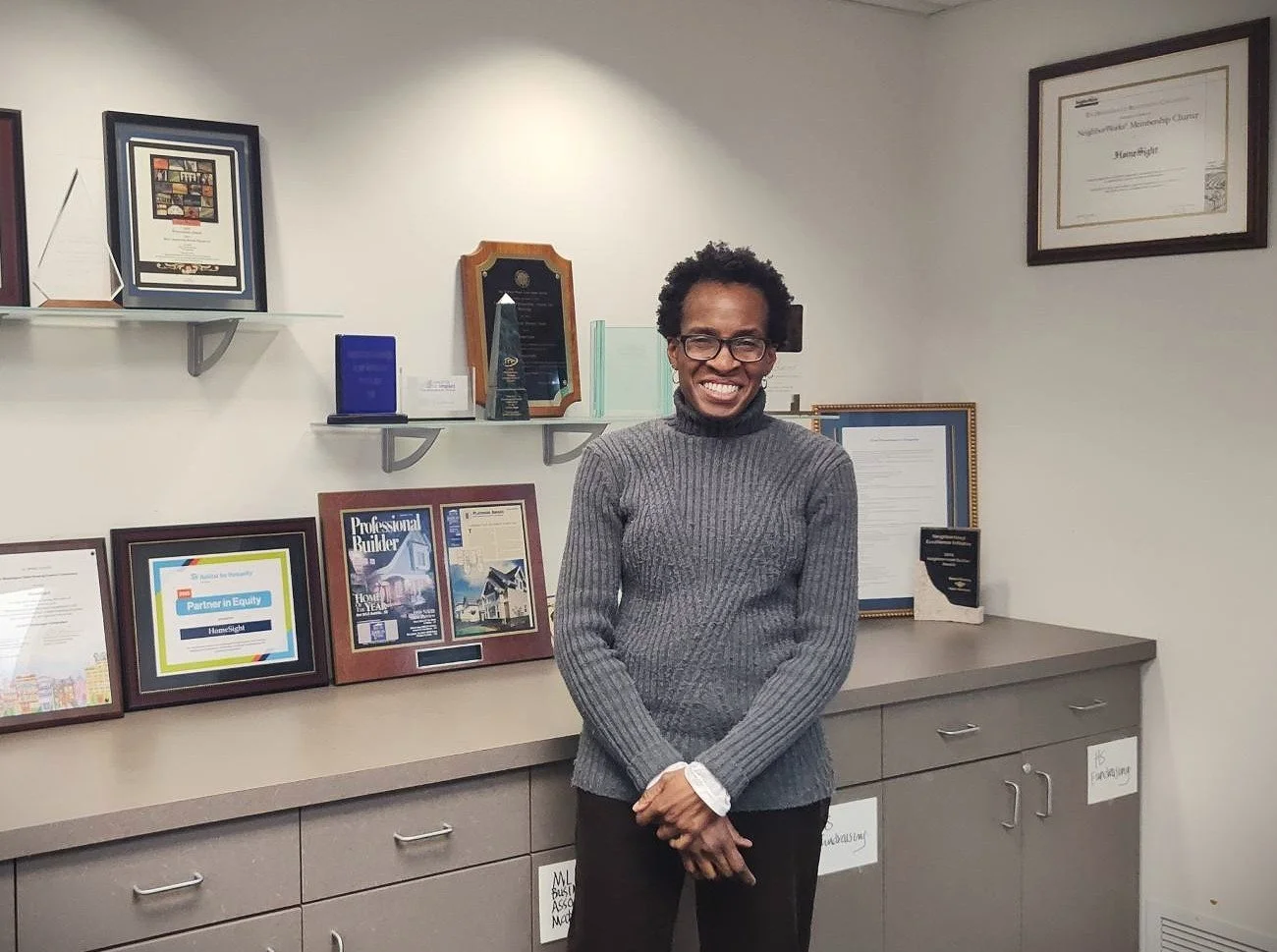
Uche Okezie, Real Estate Development Director, HomeSight (11/3/2026)
As a young person, Uche loved Mathematics and Architecture. Her education explored related fields: a bachelor's in urban studies and sociology at the University of New Orleans, then a master's in urban planning at the University of Washington's College of the Built Environment. Her thesis compared the development fees charged by for-profit and nonprofit developers using low-income housing tax credits.She was job hunting in 2002. It was before the existence of LinkedIn, so she faxed her resume to every housing provider in the Housing Development Consortium. HomeSight, a Seattle-based non-profit that advances equity in homeownership, responded. It needed a marketing intern. She was quickly promoted to Project Manager. 24 years later, she is HomeSight's Director of Real Estate Development. At the 2026 Housing WA Conference this Fall, Uche was recognized for her contributions to regional housing affordability over nearly a quarter-century, when she received the Friend of Housing award in the "Unsung Hero" category. Uche thought it was a joke when she first saw the news. She is accustomed to HomeSight's projects being nominated for awards. To be singled out for one was a very different experience. At the ceremony, she looked around at the other winners and thought, "wow.""You just do your work," She said. "It was very unexpected. I do this work because I want to help people see their dreams happen. It's a cool thing - whether it's giving somebody keys to their first home or helping a community organization build units or expand their community center... So it was definitely an honor and very humbling."
A Manager, Period
Day to day, Uche's work is similar to any other white-collar professional. She responds to emails, updates her work plan, and holds meetings. She has an eye for bringing each thread together, knowing who is or isn't speaking to each other and what the next steps on a project ought to be. "I'm the oldest of four kids", she tells me, "I'm a manager, period. I like to coordinate and make sure everybody is doing what needs to be done and that it all works together so that the outcome is good."
Her good outcomes become people's homes. A place where they can host holiday gatherings with their families and build generational wealth. Uche brings together funders and stakeholders; she cultivates new and long-standing relationships and grows the list of organizations collaborating to build housing which ordinary households can afford to buy. Uche tells me about several of these projects that represented significant milestones in her career. Milestones
Uche's first housing project, Noji Gardens, stands two blocks West of the S. Orcas and MLK intersection, in the Columbia City neighborhood of Seattle. It is a 75-home development of two-story manufactured homes. "That one stands out in my memory because it was my first project," Uche says.
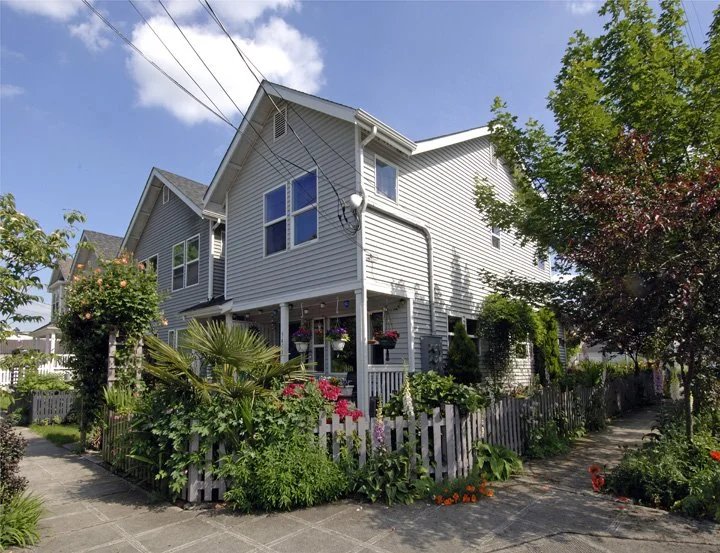
Uche's first housing project, Noji Gardens, is a 75-home development of two-story manufactured homes.
It was already in its final phase when she started working on it. Manufactured boxes had been craned into place, one on top of one another. Connections for plumbing, electrical, and mechanical elements were being pulled. Uche worked with the contractors to finish out the homes, including installing the appliances, and learned everything you need to do to close out a project. The project also introduced her to a contractor HomeSight has worked with, off and on, ever since.The next one was the Stellina, completed in 2004. It was a first in more ways than one. It was HomeSight's first condominium project, and the first where Uche worked alongside the project manager from the start of construction through close-out. It was also a demonstration project: an opportunity for Seattle's city departments to coordinate with one another."One of the problems was that the Department of Transportation, Seattle Public Utilities, Seattle City Light, and also the building department weren't working in coordination," Uche recounts. That made things difficult, without "the right hand knowing what the left hand is doing."
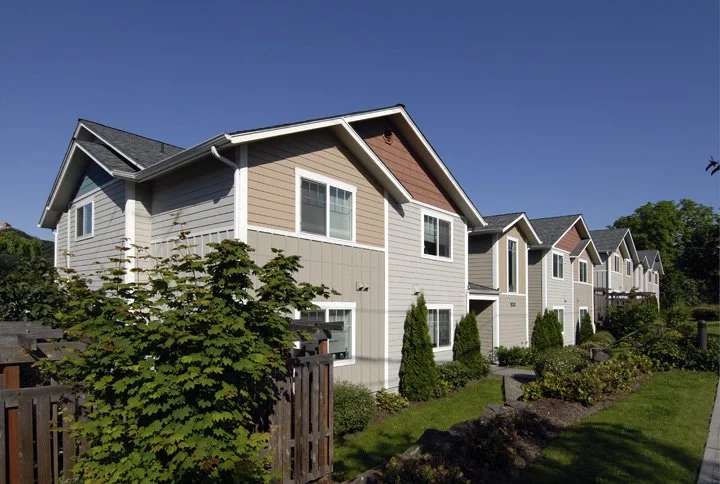
The Stellina, HomeSight's first condominium project, was completed in 2004.
The Stellina is one building but looks like three from S. Charles. It is situated on a slope and includes a lower garage. Beneath an attached piece of land, water from the Cedar River flows through a large and fragile concrete pipe called a culvert. The project got an easement from the city so a P-Patch could be placed on top, which protects the pipe: with a garden there, nobody will drive over it. "So, it was cool," she says.Her next project, the Cokoffi, near 13th and Columbia by Seattle University, is the one she is most proud of. There were "lots of challenges," she says. "I did it all by myself." She doesn't mean she was alone. She made the decisions, managed the budget, and coordinated the funders, the contractor, and the city departments. She was the go-to person. 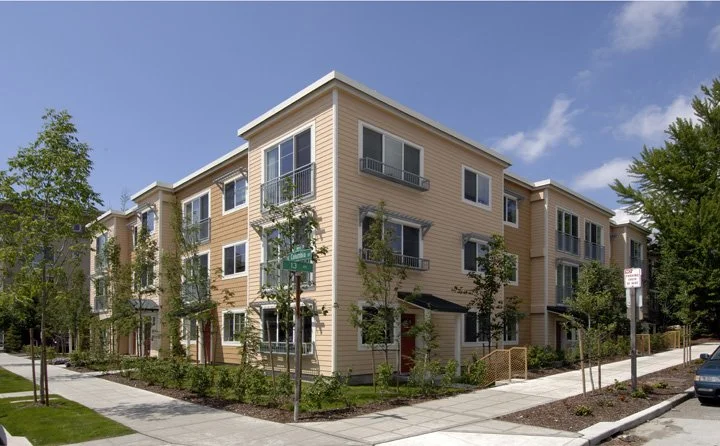
When a Project Can't Move Forward
Another project holds a different kind of pride: U-lex, a limited equity cooperative. Uche is proud of the many problems she solved over the eight years HomeSight worked on this project. Though, to Uche’s disappointment, not every problem could be solved. To avoid operating at a deficit, HomeSight sets its prices to break even. By contrast, for-profit market developers set prices based on what their target market is willing to pay, according to market studies. "Our bottom line is that the price point needs to be affordable to people at 80% or below [Area Median Income] without overburdening them." Uche says, "34 - 35% of their income, no more than that, can go to housing."
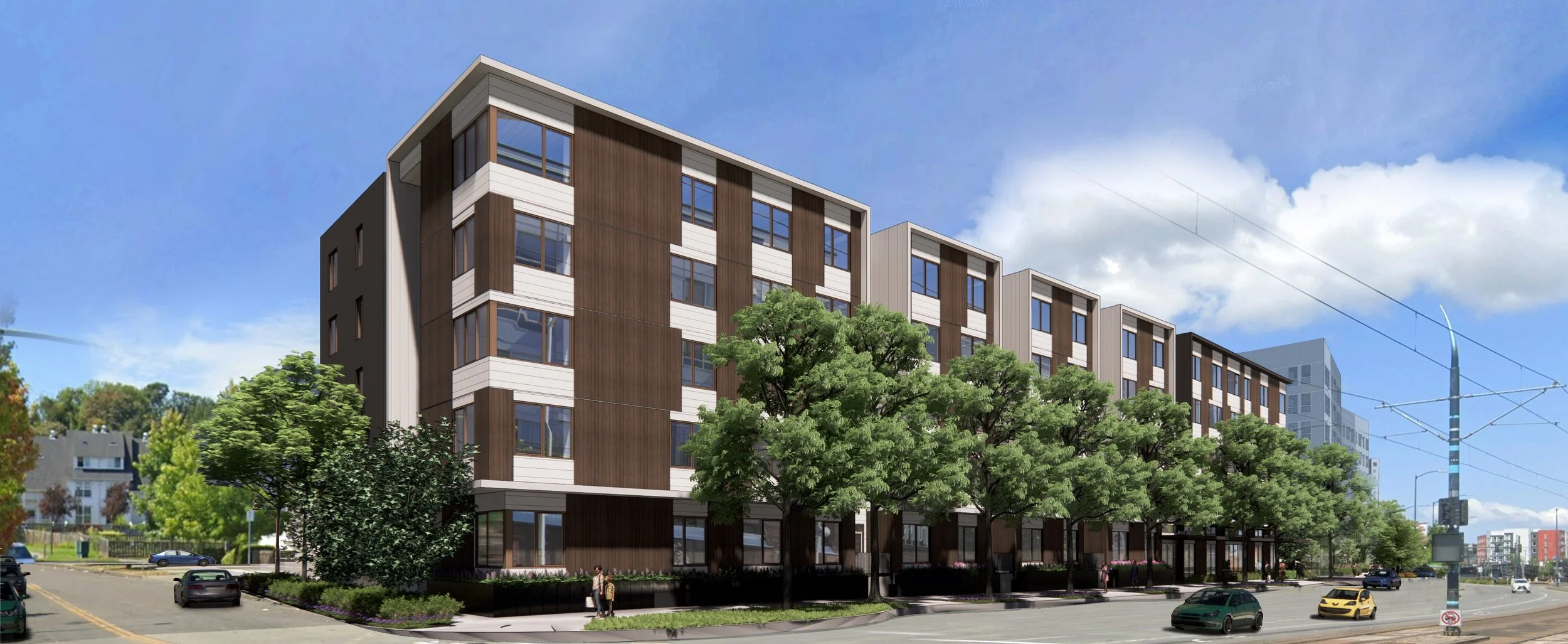
Graphic rendering of U-lex, a limited equity cooperative project that HomeSight worked on over 8 years but never completed.
Sometimes a financing gap or an expired permit will halt a project. U-lex did experience financing problems, which were resolved. Then, at the 11th hour, interest rates went up. That halted the project. Unit prices would have gone up too high. "I [had] to say we can't move forward with it because it wasn't going to produce units that were affordable to our community." She said, "And in the end, that's what we do. We make the dream of homeownership possible for people, whether it's through down payment assistance, whether it's through mortgage loans, or whether it's through the product that we're building."
Field Order 15: Building the Fund
Uche manages the Field Order 15 Fund, a reparative lending program from HomeSight and Black Home Initiative (BHI) that helps BIPOC home developers build affordable homes. Uche also contributed to the collaborative design of the program, which launched in 2024. 
The Field Order 15 Fund is a reparative lending program from HomeSight and Black Home Initiative (BHI) that helps BIPOC home developers build affordable homes.
The problem BHI wanted to address was that BIPOC developers often don't have access to the capital they need to secure a construction loan. “They have to use their own funds. It's very risky. And their access to those funds is a little bit more constrained,” Uche says, “Maybe credit cards, maybe pulling money together from family and friends. This is just to see if a project will work.”
HomeSight and community partners with BHI wanted to help address that funding gap, which meant putting together capital. But funding alone wasn’t enough. "It's sort of like wraparound services," Uche says. "Here's the funds you need, but we're also here for the technical assistance, because it's not just enough to say here's money, especially if they have never done development before."
The fund's focus is on small and emerging developers, some of whom may be on their first project. The fund’s design has been iterative; when the team learns something new, they make changes and continue improving.Supporting BIPOC Developers
Two years in, Uche points to one accomplishment above the rest: small, emerging developers have reached the point where they can actually build a project. Tacoma-based developer Kiera Daniels is one example. An early participant, she applied for a feasibility grant for her project in Tacoma and has now finished construction. Uche says she has already had two buyers who used the Covenant Homeownership program to help purchase their homes.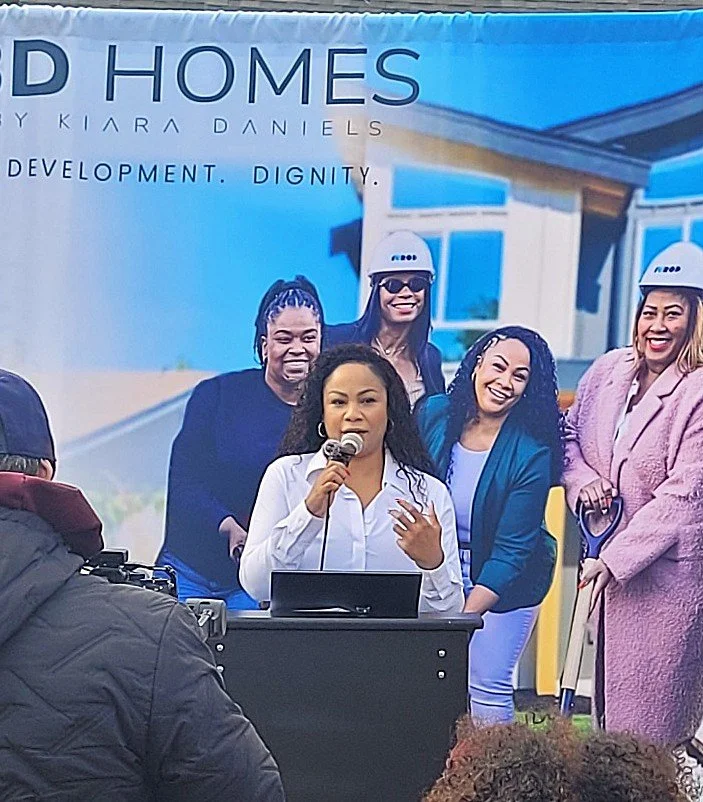
Tacoma-based developer Kiera Daniels was an early participant in the Field Order 15 Program, receiving a feasibility grant for her construction project in Tacoma, which has now been completed. Daniels held a ribbon-cutting ceremony on November 4th, 2026.
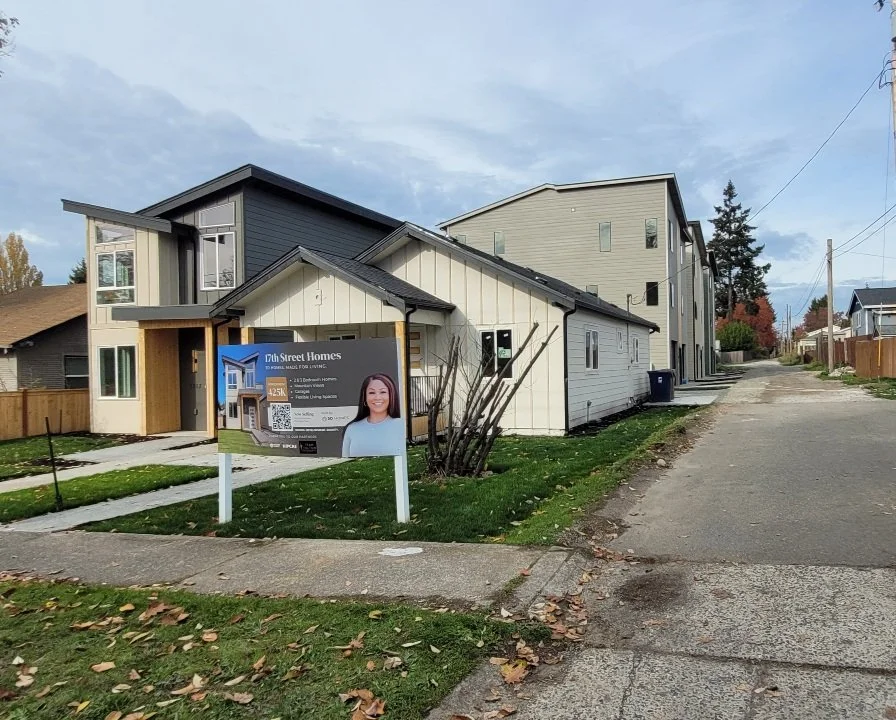
The completed 17th Street Development Project (11/4/2026)
“I think it's important to be able to give folks access to opportunity," Uche says, "a chance to do something that maybe they wouldn't have been able to."
At a convening of the fund's developers late last year, she saw what that opportunity meant. They were happy to be going further than they could have on their own, talking and collaborating, and feeling like they were part of something.Why does this matter? It matters so that more BIPOC developers are in the field, building homes for their own communities. "They know what their market wants to see, the issues that they're running into, and can solve for those things," she says, "as opposed to just doing cookie-cutter projects because you're building to turn a profit."
It is also a way for those developers to build generational wealth by starting and keeping a business.She sees it as an equity issue too. She describes the familiar picture of two people standing behind a fence, trying to see over it: what if the fence wasn't there? With access to funds and technical assistance, she says, Field Order 15 is trying to take that fence away, so that everybody has access to realizing whatever they are dreaming.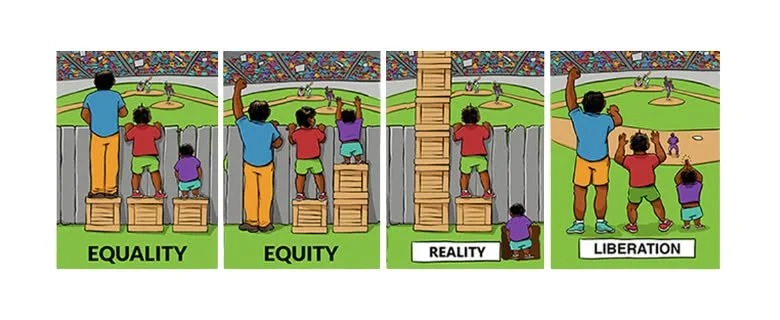
Image “Reality, Equality, Equity, Liberation,” courtesy Interaction Institute for Social Change (interactioninstitute.org), Artist: Angus Maguire.
The link to the Black Home Initiative's goal is direct: increasing the number of Black homebuyers. Developers know which agents and markets to reach and can get the word out to Black families and other families of color. The hope is that the homes they build go to those households, and Kiera Daniels's buyers are an early sign.Reflecting on a Changing Ecosystem
In the 24 years since Uche walked in the door as an intern, the work has gotten both more supported and more difficult. Over the last couple of years, she says, the signs are promising. Jurisdictions are trying hard to increase the supply of affordable housing by streamlining permitting, and she has sat through many webinars and panels asking how to make that process more coordinated. There has also been more targeted investment on the supply side, both social and public. "All of these things are an intentional way," she says, "to figure out how to bring more affordable housing to the market."
Over the longer term, larger market trends loom large for every developer in the housing ecosystem. There is less land, the land that remains is more expensive, and it costs more to build. "It's a lot harder to make things pencil," she says. "So, you have to figure out creative ways to raise funding, creative ways to get a project done."
Some themes have come full circle. At the Stellina, Uche watched four city departments that weren't working in step. Today, improving coordination across that process is a hot topic on panels and policy discussions regionwide.Looking to the Future: Less Competition, More Collaboration
If there is one thread through Uche's career, it is that good housing happens when people work together. What inspires her now, she says, is that "there's so many people who are willing to try new things." She sees more collaboration and less competition, because "competition just gets in the way of fresh ideas being explored and passed on so that maybe someone else can take it that one step further."Some examples include: down payment assistance depends on layering scarce resources from many sources: the housing commission, public funders, the Washington Homeownership Resource Center (WHRC), Catholic Community Services, Parkview Services, and others. "You have to collaborate," she says, "because the down payment assistance is from all of these different sources, all layered in together."
At the Opportunity Center at Othello Square, HomeSight is working with another affordable housing developer, Community Roots Housing, to build affordable rental homes with ground-floor commercial space for community organizations to own their own spaces. HomeSight also expects to work with whoever comes next to the site where the U-lex cooperative would have been built, because the community still wants to see affordable homeownership there. That is the kind of outcome Uche wants her work to produce. "I try to make the work that I do count," she says, "in terms of creating a lasting outcome."
In a field where resources are limited and need is great, the case for collaboration over competition is as practical as it is hopeful. Somewhere in Washington this season, a family will host its first holiday meal in a home it owns. Behind the story of that home, there was probably a manager like Uche, making sure that everyone did what needed to be done.The Black Home Initiative is a network of organizations focused on increasing Black homeownership in Washington State.
Do you remember your first holiday in your first home? Tag @blackhomeinitiative or DM us your story and use #OurHomeOurLegacy